
WHERE IS THE FREEDOM IN THE LAND OF THE FREE?”

Updated: Apr 13
A COMING MARGARET BONDS PREMIERE WORKS TO RIGHT AN OLD NEST OF WRONGS
Part 4 of 4: An Illustrated Program Note for Margaret Bonds’s Bitter Laurel
[This is the fourth and final installment in a series of posts about the premiere of Margaret Bonds's late musical drama Bitter Laurel. Part I, focusing on the biographical context for the work's creation, is available here. Part II, focusing on Elizabeth Keckley and her connections to Queens University of Charlotte, is here. And Part III links to a superb Prezi presentation and beautiful library display pulled together by Kel Williams, who will create the role of Keckley in this coming weekend's performances; that installment is available here.]
On April 18 and 19, 2026, Queens University of Charlotte (North Carolina) will offer the world premiere of a musical about the dramatic, inspiring, and unlikely intersections of the lives and works of three remarkable women. Its main subject, Elizabeth Hobbs Keckley (1818-1907), born into enslavement by the Burwell family whose name formerly adorned the main administration building at Queens, developed exceptional skills in dressmaking as well as great business savvy during her enslavement. With these she was able to purchase her own freedom and that of her son. Once free, she became a sought-after modiste in Washington, D.C., an activist on behalf of African Americans, an author, and evidently the guiding spirit in an unlikely friendship with none other than Mary Todd Lincoln (1818-82), First Lady of the United States during the presidency of Abraham Lincoln.
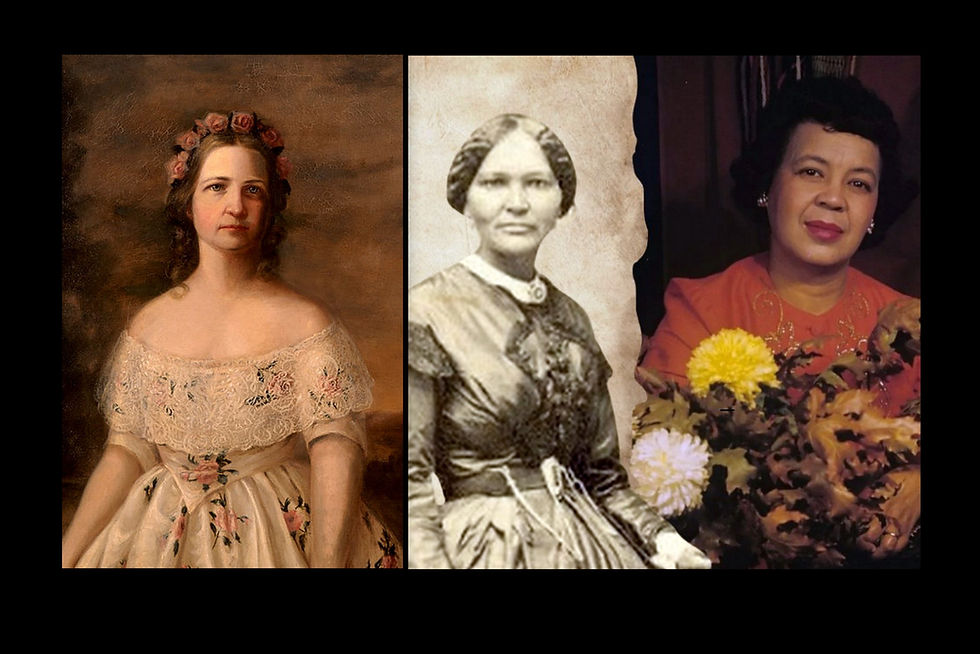
To this unlikely friendship was joined another a century later: the friendship of composer, pianist, and intrepid activist Margaret Bonds (1913-72). With a distinguished career as social-justice advocate who not only championed the poor and downtrodden at every turn but also created visionary large-scale musical compositions that celebrated historical Black notables as role models for contemporary African Americans, Bonds in 1968 assembled a team of literary collaborators who worked with her in setting Keckley’s story to music: artist, critic, and lyricist Janice Lovoos (1903-2007), actor, director, and author Edmund Penney (1926-2008), and Turkish-born playwright Demetrios Vilan (1909-2000).
Keckley and Mary Todd Lincoln were both dead before Bonds’s creative team set about their project. But in the resulting work – titled Bitter Laurel – those six voices joined together to create a new and brilliantly original musical drama that not only told the story of the Keckley-Lincoln friendship, but also drew powerful connections between the issues and themes of their lives and those of the late 1960s and early 1970s – connections that, in many cases, resonate startlingly with those of our own world today.
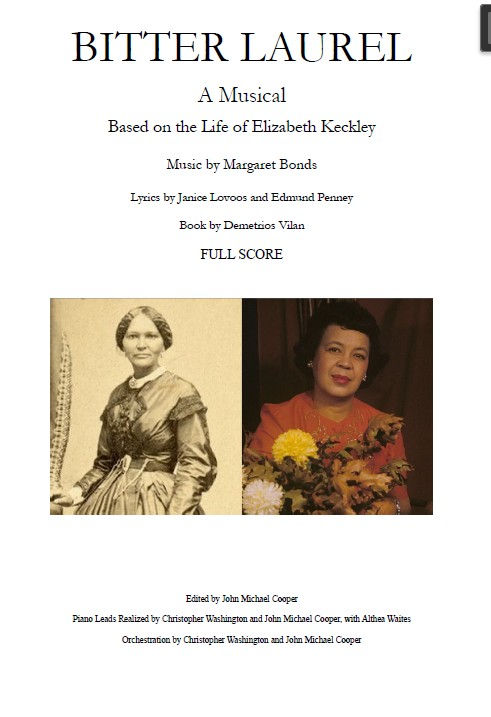
What follows is an illustrated program note for Bitter Laurel. The music examples are given both in mp3 and score formats. The mp3s are Finale-generated audio excerpts (textless). The scores -- compiled in this shared Google Drive doc -- are excerpted from the piano-vocal score that will be published by Hildegard Publishing Company (although the April 2026 performances are done with orchestra).
Act I (Washington, D.C., 1860-66). As the musical begins, we see a gathering of white citizens celebrating the presidential candidacy of Abraham Lincoln’s rival in the 1860 presidential election, Stephen A. Douglas, drawing particular attention to Douglas’s pledge to defend and uphold the “domestic institution” of enslavement (Ex. 1a). Elizabeth Keckley, now a free woman and newly arrived in Washington, enters and, awed by the grandeur of the Capitol, sings the anthem “What a Big World This Is” – whose words “What a big world this is! There must be room for all of us; though it grieves us and deceives us, Hope will still burn bright – it’s for the big and small of us” are a hymn to equality, inclusion, and freedom: “Long as we are free, we’ll find a way of sharing it.” (Ex. 1b). Having obtained the special license required of Black folk, Keckley opens her own tailory shop and hires an assistant, Sarah Bond, who will provide valuable support as she builds her life. She also becomes the founding president of a “Contraband Relief Society” aimed at helping formerly enslaved Black folk find their ways in the free world.
Over the course of Act I, Keckley wins a position as modiste for Mary Todd Lincoln, and a bond of friendship takes root between the two. Keckley wishes that her son, George, conceived of rape during her enslavement and raised by Elizabeth Keckley and an informal stepfather, Jim, could see her now (Ex. 2), and as it happens George pays her a surprise visit in her shop. But he also tells her that he has set aside his education at Wilberforce University to enlist in the Union Army’s fight against the enslavement of his people. Keckley, though distressed at her son’s having entered the looming “white man’s war,” tries to be supportive – but her worries prove tragically correct: George Keckley is killed in the Battle of Wilson’s Creek, leading to Keckley’s despondent “Oh, Black Moon Shining” (Ex. 3a), with its resolutely positive “brand new marching song” (Ex. 3b) and finally the searing pathos of its climactic lines of “where is the freedom in this land of the free? And what good’s my freedom without my son?” (Ex. 3c).
In the ensuing scene Keckley, immersing herself in her work to drown her sorrow, is approached by a conniving author who wants to be introduced into the Lincoln White House, but she rebuffs her in a powerful display of loyalty to the First Lady. A poignant reminiscence of her romance with Jim Keckley (“Old Enough to Know”; Ex. 4) is followed by the heartening news of Abraham Lincoln’s reelection and African Americans’ joyous celebration of that news (the rollicking gospel number “We Got a Moses”; Ex. 5), but the growing optimism attendant to that event is shattered by Lincoln’s tragic assassination, which leads to Keckley’s bleak songful meditation “Bitter Laurel,” from which the musical takes its name (Ex. 6). The remainder of the act shows Keckley’s and Mary Todd’s bond of friendship growing as they worry about how to create a new future together and address the former First Lady’s mountain of debt. The act closes with a reprise of “What a Big World This Is.” That number’s closing lines – “gotta look ahead in this fine new world of the free!” – offer a prophecy of sorts, for although the war is over and the forces of enslavement have finally been defeated, they have been succeeded by other frightful concerns that require more forward-looking resolve (Ex. 7).
Act II: New York, 1866-67. With only sparse provisions for widows and no reasonably dignified sources of income for women, Mary Todd’s debts have become a major concern. In order to address them, Keckley has suggested that they travel to New York and take advantage of the city’s bustling diversity to sell some of them; this change of scene is depicted in the expansive chorus “In New York” (Ex. 8). In order to avoid impressions of impropriety, they insist on doing so anonymously. Unfortunately, the firm hired to sell the clothes instead makes a circus of the event, publicizing the fact that the clothes on sale are those of the widow of the slain President (Ex. 9). The attention produces what came to be known as “the old clothes scandal.” Tensions pursuant to that controversy lead to the musical’s first and only falling-out between Elizabeth Keckley and Mary Todd, and this in turn leads to Mary Todd’s melancholy reflection “Many Little Things” (Ex. 10). But when the former First Lady comes close to a nervous breakdown and, distraught, cries out for Keckley, her friend once again comes to her aid – a reconciliation that leads to a reprise of the duet “Prosperity’s Smiling,” its earlier boisterous waltz now replaced by music of a glowing and exquisitely tender intimacy (Ex. 11).
The musical closes in Keckley’s garret room in Greenwich Village. A warm exchange with her friend Amelia is followed by “Friends” – a musical reflection, at turns poignant and joyous, on the numerous intersecting friendships of Keckley’s journey up to that point (Ex. 12) – and as Amelia leaves a new visitor arrives: Hamilton Busby, come to solicit Elizabeth Keckley to write and publish what would become her bestselling memoir of her White House years (Behind the Scenes; or, Thirty Years a Slave and Four Years in the White House). Keckley’s bewilderment at this invitation is interrupted by the return of her friend and former assistant Sarah, who brings the bright news that her professor at Wilberforce University wants Keckley to join the faculty there. Sarah’s beau, Aaron, arrives and inadvertently leaks the news that Jim, Keckley’s old lover (about whom she reminisced in “Old Enough to Know”), is in town and that the younger couple has arranged the older couple’s reunion – and as the group leaves for Keckley to be reunited with her long-lost love the anthem “What a Big World This Is,” with its closing assertion to always “look ahead in this fine new world of the free,” returns (Ex. 13).
Bitter Laurel is the magnum opus of Margaret Bonds’s final years, but she never saw it performed. The most likely reasons are distressingly prosaic. First, she and her team did most of their work on it in 1968-69, before she assumed her position as musical director of the Repertory Theater at the newly founded Inner City Cultural Center of Los Angeles – a position that, coupled with the large piano studio she developed, took most of Bonds’s time and energy and left little room for the massive amount of work involved in bringing a musical to the stage. Additionally, librettist Demetrios Vilan was on an extended trip to his native Turkey and Greece when Bonds died suddenly on April 26, 1972. News of her death shocked much of the musical world and left the unperformed musical in limbo – complete in all its essentials but never heard, its book and scores soon lost in the mass of papers that the composer left behind.
Those circumstances doomed Margaret Bonds’s late masterpiece to obscurity for more than half a century. But that period of oblivion is now reaching its end thanks to the determination of Queens University, which formerly honored the very family that enslaved Elizabeth Keckley, to do right where so much wrong was done before. And as Bitter Laurel finally makes its way into the world there is good reason for all involved to do what the musical’s book, and indeed the lives of Keckley and Bonds alike, urge us to do – to “look ahead” and continue our strivings to do better in the intersecting causes of addressing injustice and advancing freedom in “this fine new world of the free.”
It's happening, finally. Today was the first Sitzprobe, and the coming week is full of rehearsals and all manner of other preparations!


Comments